


Who Controls the Story? What Screenwriters Can Learn from You Can See Everything


You Can See Everything will make audiences question what is real in the movie and what’s staged (though some are more obvious than others).
It is considered a documentary, a form often presented as windows into reality that capture people and events as they unfold. Documentaries can vary in length (the Academy Awards have a feature-length and short category) from feature-length My Octopus Teacher, a 10-hour Ken Burns documentary on the Civil War or a Dateline episode.
But how much of what we see is spontaneous and how much is being shaped by the filmmaker? A Dateline episode has interviews but also b-roll of the detectives and family members walking down the streets of their town, which is staged for the camera. And you can imagine Michael Moore consulting with his team about how he’s going to confront someone. Is Borat considered a documentary? Even historical documentaries will have reenactments. Therefore, what might look like an ordinary moment
might have been staged, reconstructed or selected to support a larger narrative.
Nathan Fielder, the filmmaker behind You Can See Everything, pushes this idea by blending observational footage, scripted reenactments and staged situations to explore the life of Elizabeth Holmes, the infamous founder of Theranos, 34 days before going to prison. Fielder doesn’t just record her life, along with fiancé, Billy Evans, but also becomes a part of the story.
You Can See Everything offers a fascinating look at how documentaries are constructed, providing a glimpse into how they’re made and what it means to dramatize events that weren’t captured on camera as well as challenging the subject of the story.
Documentaries are rooted in reality, but just like in feature films, someone still has to decide how the story unfolds.
Reenactments: Writing Scenes from Incomplete Information
What happens when Elizabeth Holmes isn’t on camera but there’s something interesting to document? In Fielder’s case, hire the actress who played her in a mini-series. Amanda Seyfried, who portrayed Holmes in the series The Dropout, becomes part of the documentary about halfway into the movie when Fielder shows her the first half of the film.
Seyfried finds herself a subject in the documentary, interviewing Evans and then playing the Holmes role in reenactments. Although there isn’t footage available, Seyfried (as Holmes) recreates moments that Fielder felt important to advance the story he wanted to tell. For example, when Fielder and Holmes discuss the documentary and when Fielder, along with A24, meet with Holmes and Evans at their home.
These scenes, which are scripted and acted out, give audiences access to events that might have otherwise been relayed through interviews or omitted entirely.
The same challenge applies to feature films based on true stories: How do you write a scene when you weren’t there to witness it? Consider Braveheart, 12 Years a Slave or Michael. While not documentaries, they are based on true stories and built from accounts of what happened. This means the filmmaker must make choices about dialogue, behavior, setting and what information to include. Even if you’re writing a movie based on recent events like The Social Reckoning does, the writer is crafting a story
based on someone’s recollection or interpretation of events rather than an objective record.
Fielder’s reenactments are based on his recall and, while he obviously has a first-hand account of what happened, the information is limited by his memory – and no one’s memory is perfect. His job was to take what he knew and write a compelling scene without losing sight of its purpose.
Whether a biopic, historical drama, reenactment for a documentary or something else, it’s the writer’s story to tell and they’re the ones who choose what the audience sees and what remains unknown.
Every Story Has an Angle

A documentary might be based on real events, but every filmmaker comes in with their own perspective they want to share. When Michael Moore made his Academy Award-winning documentary Bowling for Columbine, it was his perspective on guns and the media that drove the narrative. Even Fielder comes into You Can See Everything with his own perspective, as do Holmes and Evans.
Subjects have their own reasons for participating in a documentary, whether they want to use the platform to explain their actions, reshape public perception or take control of a story. But the filmmaker has their own perspective and agenda as well. These competing ideas are similar to two characters in a fictional film with different motivations.
Holmes and Evans wanted someone to document this time in their life so, in some way, they were eager to control the narrative. They also wanted to take hold of their public image. Considering the access and given her history, audiences may question what Holmes was willing to reveal, confirm or leave out. However, it was up to Fielder to navigate the overall story and find a way to present it to audiences.
If you’re writing a screenplay based on real events, consider the perspectives of the characters and their angle of the story. Start with whose perspective drives the narrative and what they stand to gain from telling their version of events. Recent biopics like Rocketman and Better Man were produced with the involvement of their subjects, Elton John and Robbie Williams, respectively. They have an angle in how their story is told and had an active role in how their life was interpreted. How does a subject’s involvement influence which parts of their life make it onto the screen and how those events are
interpreted?
The most interesting documentaries and films based on true events don’t just highlight real life but challenge the subject and provide a new perspective. Even Shrek’s perspective is challenged, but how would the story change if it was from Lord Farquaad’s angle?
When New Characters Enter the Frame
Introducing the right character to a situation can change the dynamic between existing characters, introduce conflict or reveal information that shifts the audience’s understanding of events. In You Can See Everything, the filmmaker is the new character to the dynamic.
While most documentary filmmakers stay out of frame, Fielder is in it from the beginning. His constant presence challenges Holmes and Evans by asking questions and creating situations – the Abbott and Costello scene is perhaps the shining example of how Fielder’s presence pushes the audience’s viewpoint of a character.
And then, a new character enters the mix: Amanda Seyfried. She not only portrays Holmes in several reenactments but her reactions, commentary to events and interview with Evans change how the documentary unfolds.

Neither Seyfried nor Fielder is an objective bystander. Their involvement creates new opportunities for the story to develop.
Screenwriters can use this approach when introducing characters in their screenplay or changing the momentum partway through the film. A new character shouldn’t be there to deliver information but alter the existing relationships of the scenes they share with the other characters.
Consider Tommy (Gil Bellows) in The Shawshank Redemption, for example. He’s a young prisoner who comes to Shawshank – about halfway into the movie – where Andy (Tim Robbins) helps receive his high school diploma. This gives Andy purpose. The crucial shift happens though when it’s revealed that Tommy knows who killed Andy’s wife. This changes the dynamic of the prisoners and the warden. Tommy doesn’t show up as a new prisoner to mix things up, he’s there to challenge the protagonist and
the characters he interacts with.
New characters can:
Expose a secret
Challenge someone’s version of events
Create unexpected alliances
Scriptwriting in True Stories
Throughout You Can See Everything, some of Holmes and Evans’ answers feel unusually rehearsed or calculated, almost like a politician delivering a prepared response. At times, when they struggle to answer a question that Fielder presses them on, they get interrupted or something moves the conversation in a different direction.
These moments may leave audiences scratching their heads. Was this scripted? How did Evans know the right moment to walk in when Fielder was talking to Holmes’ father? Other times, it feels like the filmmakers said, “that’s great, let’s try the conversation again.”
Regardless of whether the scene was scripted, planned or another take was given to help with clarity, the point is that not everything needs to be spontaneous to get the ideas across. It’s the context that matters.
When writing real people, you can’t always know exactly what they said or thought. Screenwriters can look at these moments and see that dialogue is more than words. If you’re writing a true story, the context can be more important than the words spoken.

Never Stop Challenging the Audience
You Can See Everything constantly challenges audiences by prompting them to question the truth behind what they’re seeing on screen.
Whether you’re writing a documentary, historical drama, true crime series or biopic, the goal isn’t to just recreate events. Screenwriters need to shape the story into a compelling narrative. Reenactments can fill in the gaps, when necessary, and new characters can change the dynamics of a scene and make the audience see a different perspective.
Like Fielder though, a filmmaker controls how a story unfolds and determines the best way to tell it to an audience. By making deliberate choices, they can shape the perspective of characters as well as how the audience sees them.
World's best Producers are looking for Feature Screenplays to Produce
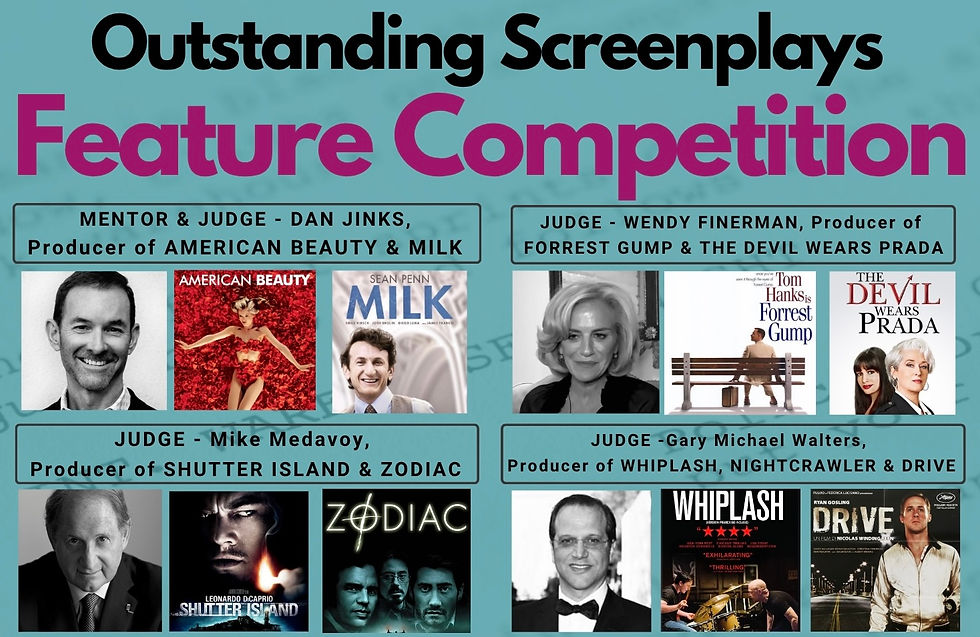
Judges for the Outstanding Screenplays Feature Competition include:
Dan Jinks - Oscar Winner for American Beauty
Wendy Finerman - Oscar Winner for Forrest Gump
Adam Novak - Head of Story Development for Literary Agency WME
Gary Michael Walters - Producer of Drive, Nightcrawler, and Whiplash
Mike Medavoy - Producer of Shutter Island, Zodiac and Black Swan
Writers will receive an EXCLUSIVE one-page written
feedback report from these judges!
Grand Prize Winner(s):
* $5,000 Guaranteed Option for the Overall Winner!
This is your real chance at getting your script made into a feature film!
MENTORSHIP with Academy Award® Winner DAN JINKS (Producer of American Beauty)
6 x $500 in Cash to each of our 6 GENRE Prize Winners.
Best Action & Adventure - $500 for the Winner
Best Comedy - $500 for the Winner
Best Drama - $500 for the Winner
Best Horror - $500 for the Winner
Best Sci-Fi & Fantasy - $500 for the Winner
Best True Story & Public Domain - $500 for the Winner


Comments